
Why the answer is far more complicated than Instagram makes out
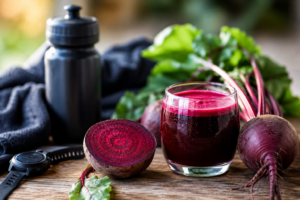
Beetroot juice shots seem to be everywhere in endurance sport now.
You’ll often see athletes taking them before races, talking about “boosting nitric oxide”, improving blood flow, or reducing the oxygen cost of exercise.
And for some athletes, particularly men, there is good evidence showing nitrate supplementation can improve endurance performance.
But here’s the problem:
Most of the original research was done on men.
Not women.
And once you start looking at female physiology, hormones, peri-menopause, menopause, and HRT, the picture becomes far more nuanced.
So let’s break it down properly.
What beetroot juice is supposed to do
Beetroot juice is high in dietary nitrates.
These nitrates are converted in the body into nitric oxide (NO), which helps:
- Widen blood vessels (vasodilation)
- Improve blood flow
- Improve oxygen delivery
- Reduce the oxygen cost of exercise
- Potentially improve endurance performance
This is why nitrate shots became popular in cycling, triathlon, and running.
In men, research has consistently shown:
- Improved exercise economy
- Improved time trial performance
- Reduced oxygen cost during submaximal exercise
- Small but meaningful endurance gains
This is especially true in recreational and moderately trained male athletes.
But this is where things start to change for women.
Female athletes are not small men
This is one of the biggest issues in sports science.
For years, most exercise physiology research was done on:
- Young
- Healthy
- Male athletes
Then the findings were simply applied to women.
But female physiology is not just a smaller version of male physiology.
Hormones significantly affect:
- Metabolism
- Thermoregulation
- Recovery
- Hydration
- Fuel usage
- Vascular function
- Nervous system response
- Nitric oxide production
Which means supplements may not affect women in the same way they affect men.
The oestrogen and nitric oxide connection
One of the key things Dr Stacy Sims discusses is the relationship between oestrogen and nitric oxide production.
Oestrogen naturally stimulates nitric oxide production in the body.
This means many pre-menopausal women already have:
- Greater vasodilation
- More flexible blood vessels
- Higher endogenous nitric oxide availability
Compared to men.
So while men may benefit from adding external nitrates through beetroot juice, women may already have a well-functioning nitric oxide system due to healthy hormone levels.
This is where the theory becomes interesting.
Could nitrate supplementation actually interfere in some women?
Some emerging female-specific research suggests that introducing high doses of external nitrates into women with healthy reproductive hormone levels may interfere with the body’s natural oestrogen-mediated nitric oxide pathways.
In simple terms:
The body may already be doing the job effectively on its own.
Some studies in pre-menopausal women have shown:
- Little performance benefit
- Blunted responses compared to men
- No improvement in exercise economy
- And in some cases, even small reductions in performance markers such as VO₂ max
This doesn’t necessarily mean beetroot juice is “bad”.
But it does mean the response appears very different from what is typically seen in men.
Why the research is still confusing
One of the biggest problems in female sports science research is that many studies still fail to properly control for:
- Menstrual cycle phase
- Contraceptive use
- Peri-menopausal status
- Hormone fluctuations
- HRT use
This matters enormously.
A woman in:
- The follicular phase
- The luteal phase
- Peri-menopause
- Post-menopause
- or on HRT
…may all respond differently to the exact same supplement.
So when you see headlines online saying:
“Beetroot juice improves endurance”
The real answer is often:
“It depends who you are.”
What about peri-menopausal women?
This is probably the most complex category of all.
During peri-menopause:
- Hormones fluctuate unpredictably
- Oestrogen can spike and crash
- Thermoregulation changes
- Recovery changes
- Vascular responses can change
This means nitrate supplementation may:
- help some women
- do nothing for others
- or potentially worsen symptoms in some situations
Responses may also vary depending on:
- Stress
- Sleep
- Heat
- Cycle timing
- Fuelling
- Hydration
- Training load
Which is why blanket supplement advice becomes problematic.
Post-menopause changes the picture again
After menopause, oestrogen levels decline significantly.
This can lead to:
- Reduced nitric oxide production
- Reduced vascular flexibility
- Increased vascular stiffness
- Higher blood pressure risk
- Changes in circulation
This is where nitrate supplementation may potentially become more useful again.
In post-menopausal women not using HRT, beetroot juice may help mimic some of the vasodilatory effects previously supported by oestrogen.
This means some post-menopausal women may respond more similarly to male athletes.
But what about post-menopausal women on HRT?
This is where another layer gets added.
If a post-menopausal woman is taking oestrogen-based HRT:
- Nitric oxide production may already be partially restored
- Vascular function may improve again
- Blood vessel flexibility may increase
So now the question becomes:
Does adding nitrate supplementation provide any additional benefit?
And currently:
We simply do not have enough good female-specific research to say confidently.
Some women on HRT may still benefit.
Others may notice very little difference.
It may depend on:
- HRT type
- Oral vs transdermal delivery
- Dosage
- Training status
- Cardiovascular health
- Heat stress
- Individual physiology
Performance benefit vs health benefit
Another important distinction:
Performance effects are not the same as health effects.
Even if beetroot juice does not significantly improve race performance for some women, it may still:
- Support vascular health
- Improve circulation
- Support blood pressure regulation
- Benefit cardiovascular function
Particularly in older populations.
So the conversation should not become:
“Beetroot juice is bad.”
The real conversation is:
“It may not affect all athletes in the same way.”
So should female athletes use beetroot juice?
The honest answer is:
possibly.
But not blindly.
This is where testing and individualisation matter.
Rather than assuming a supplement will work because:
- An influencer uses it
- A male athlete benefits from it
- A study in men showed improvements
Female athletes should test responses in training first.
Things to monitor include:
- Perceived effort
- Pacing
- Power output
- Heart rate
- Heat tolerance
- Gut comfort
- Recovery
- Overall performance
The bigger lesson here
This is about far more than beetroot juice.
It highlights a much bigger issue in endurance sport:
Women are still under-researched.
And female athletes deserve nutrition and performance advice that actually considers:
- Hormones
- Menstrual cycles
- Peri-menopause
- Menopause
- HRT
- and Female physiology
Not simply recycled advice from male research.
Final takeaway
Beetroot juice and nitrate supplementation can absolutely improve endurance performance in many male athletes.
But in women, the response appears far more dependent on:
- Hormonal status
- Reproductive stage
- Menopause status
- HRT use
- and Individual physiology
For some women:
It may help.
For others:
It may do very little.
And for some pre-menopausal women:
It may even blunt performance responses.
Which is exactly why female athletes should stop assuming that what works for men will automatically work for them too.
Female athletes are not small men.